An AI scribe for optometry or ophthalmology is software that listens to an eye exam, turns the conversation into a structured chart note and hands it to the provider to review and sign. It does the typing. You make the clinical calls.
That matters because charting is eating the day. In a 2025 national survey of 1,436 US optometrists, 53.6% reported burnout symptoms, and burnout ran higher among EHR users (54.9%) than among providers without one (37.2%).
Key takeaways
- An AI scribe captures the exam conversation and drafts the note in your chart's fields. The provider reviews and signs every note.
- Independent research shows real, modest time savings: about 16 minutes per 8-hour clinical day in a large 2026 JAMA study, and more for heavy users.
- Eye care needs a scribe that knows eye care, like refractions split by eye, IOP, and anterior and posterior segment findings.
- The biggest gains come when the scribe lives inside your EHR, so there's no copy-and-paste step.
- Before you buy, ask about accuracy, HIPAA and a signed BAA, and exactly how the note lands in the chart.
How does an AI scribe work during an eye exam?
An AI scribe records the conversation in the exam room, converts speech to text and sorts what it hears into chart sections like history, visual acuity, refraction and ocular health. Some tools draft the note after the exam; others fill in the chart live as you go. The provider reads it, fixes anything that's off and signs it.
Here's what that looks like in a real exam:
- You start the session. Usually one click or tap once the patient has agreed to the recording.
- The scribe listens. It picks up the history in the patient's own words, plus every finding you call out.
- It sorts as it goes. Say "OD minus 2.75, minus 1.25 times 015, add plus 2.00" and the sphere, cylinder, axis and add land in the refraction section for the right eye.
- The note builds while you work. The best scribes fill in the chart live, so history, findings, assessment and plan show up in real time instead of all at once after the patient leaves. (Barti AI Scribe works this way.) You can glance over and catch a miss while the patient is still in the chair.
- You review and sign. Edit a line, add a thought, then sign. Nothing reaches the record without you.
Most scribes document what's said. They don't read your OCT scan or fundus photo. They record your interpretation of it, so keep talking through what you see.
Does an AI scribe actually save time?
Yes, though the size of the savings depends on how often you use it. A 2026 JAMA study of 8,581 clinicians found adopters spent about 16 fewer minutes on documentation per 8-hour clinical day. Clinicians who used one for at least half their visits saved about 27 minutes.
At 27 minutes a day, that's roughly 2 hours a week of charting that doesn't follow you home.
The tool matters too. In a randomized trial of 238 physicians, one scribe cut time-in-note by 9.5%, while another showed no significant change.
So "we have AI" isn't enough. Ask how it performs on your exams.
Eye care-specific tools can do better than the averages, since they're built around the exam you actually run. Here's how one Barti provider put it:
"Barti's AI Scribe is saving me 40-60 mins per day. I was thinking of hiring a human scribe but Barti is like gaining a full time employee."
Dr. Jason Mackay
Hidden Valley Eye Care
What should an AI scribe for eye care capture?
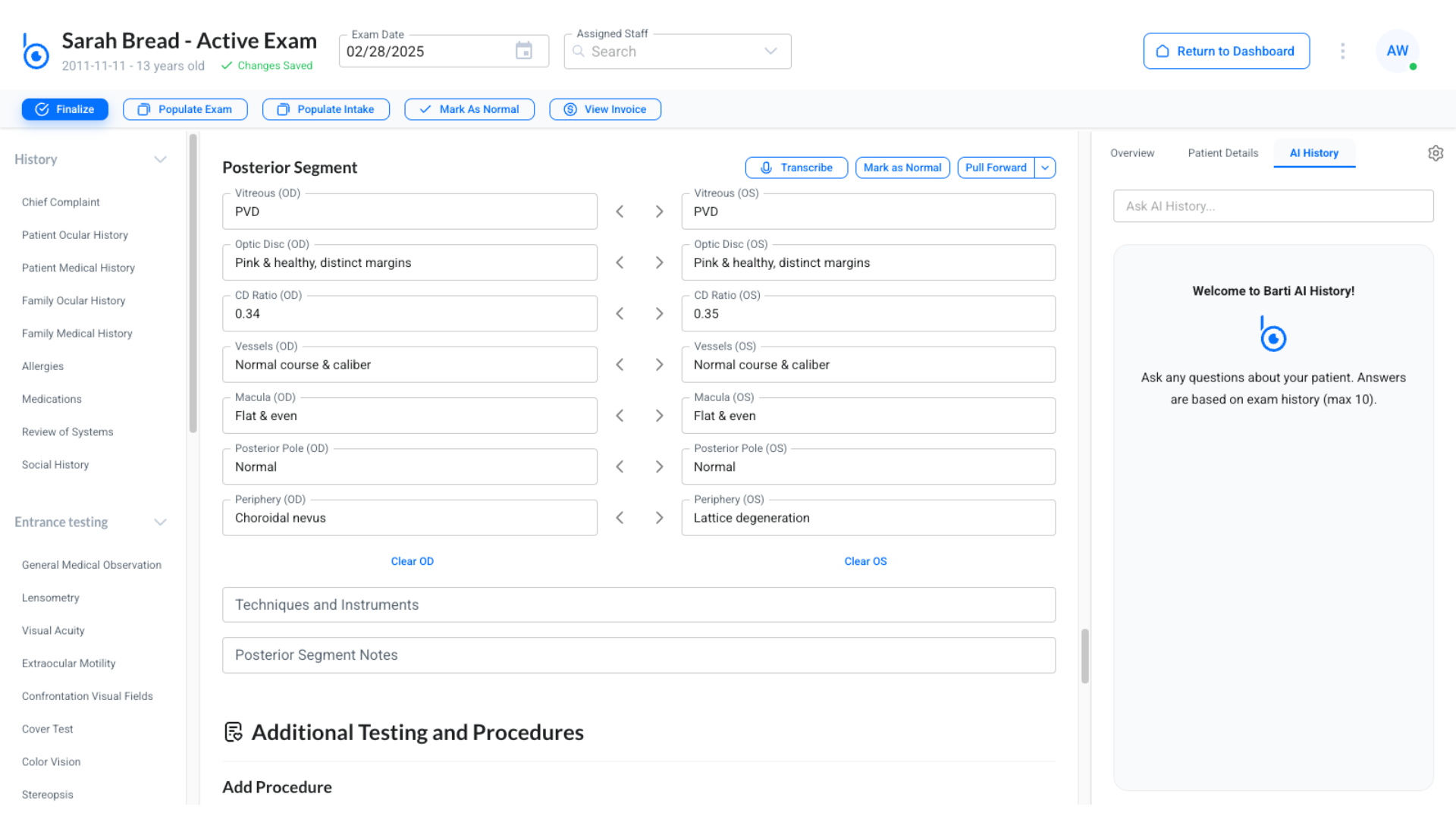
A good eye care scribe captures the full exam in the right fields, from chief complaint through assessment and plan. It should keep refraction values separate for each eye and record IOP and both anterior and posterior segment findings. A general medical scribe built for primary care may not know where a cylinder axis goes.
{{ai-scribe-exam-table="/rich-text-component-page"}}
The simplest test during a trial: run a real refraction out loud and see where every number lands. If you have to fix it every time, keep looking.
Is an AI scribe HIPAA compliant?
It can be, but you have to check. Look for a vendor that signs a Business Associate Agreement (BAA), encrypts audio and notes in transit and at rest, and tells you how long recordings are kept.
Consent is the other piece. Some states require everyone in a conversation to agree to a recording, so build a short consent step into check-in.
Standalone AI scribe or one built into your EHR?
For most small practices, built-in wins. A standalone scribe drafts a note you copy and paste into your EHR, which adds a step to every single visit. A scribe inside your EHR writes straight into the chart fields, so the note is already in the record when you're done.
Standalone tools make sense if you love your EHR and just want help with notes.
But if your EHR is slow, or you're juggling separate tools for phones, intake and billing, the scribe is a good reason to look at the whole stack. Our guide on how to choose an AI EHR walks through what to look for.
Will an AI scribe replace my scribe or technician?
It replaces the typing, which frees your people for the work only they can do. Techs can run pretesting, help patients choose frames and keep the schedule moving instead of transcribing. When you're already short-staffed, that's often a bigger win than the minutes saved on charting.
On the clinical side, an AI scribe is AI-assisted documentation. It doesn't diagnose, and it doesn't decide anything. Every call stays with the provider.
How Barti helps with exam documentation
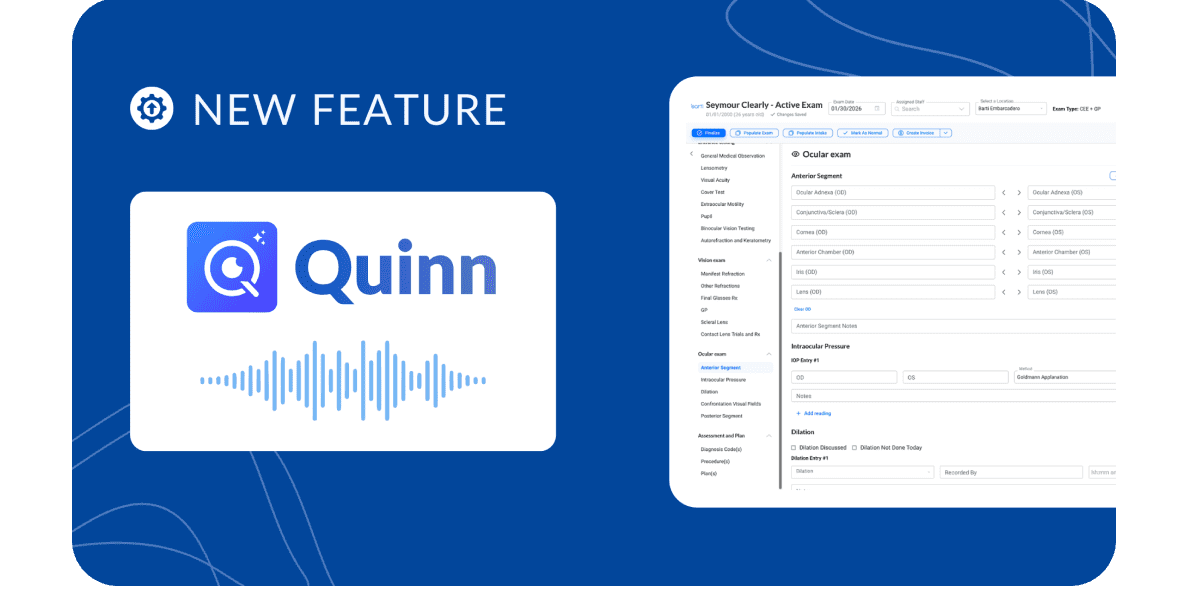
Barti AI Scribe drafts your exam note while you talk to your patient, and it files findings into the Barti chart in real time, as you say them. It's part of Quinn, Barti's AI built for eye care, and it captures anterior and posterior segment findings, from conjunctivitis to optic nerve assessments.
Since it lives in the same platform as your schedule, intake, phones and billing, there's no copy-and-paste and no second log-in. Practices on Barti save 10+ hours a week by cutting manual entry.
Want the product details? Read the AI Scribe launch post or browse Barti case studies to see how practices use it day to day.
Frequently asked questions
{{ai-scribe-faq="/rich-text-component-page"}}
See AI Scribe on a real eye exam
Bring your toughest charting day and we'll show you what the note looks like when it writes itself. Book a demo.