An AI EHR for eye care puts your charts, schedule, phones, texting and billing in one system, with AI that does real work inside it: charting the exam, answering calls, scrubbing claims. To choose one, score every vendor on 6 things: data coverage, AI effectiveness, platform architecture, workflow activation, ease of adoption, and security.
Every vendor now says "AI-powered." This guide shows you how to make them prove it.
Key takeaways
- An AI EHR works in 3 layers: one patient record (data), AI that understands the whole record (intelligence), and agents that finish tasks (action).
- AI can only help with what it can see. If your phones, billing or optical data live in other tools, the AI is working with half the picture.
- Eye care AI has to chart into structured fields, in eye care terms, including refractions and contact lens Rx.
- Make vendors show you each claim live in the demo. Our free AI EHR Buyer's Guide includes a printable scorecard for exactly that.
- AI drafts, the provider decides. Every note, guideline and claim should get a human review.
What is an AI EHR?
An AI EHR is an electronic health record with AI built into the core, plus the practice management, phone, texting and billing tools that usually live elsewhere. It keeps every patient detail in one record, so AI can draft notes, flag follow-ups and handle front desk tasks with the full picture in view.
The best systems work in 3 layers:
{{ai-ehr-layers-table="/rich-text-component-page"}}
Most practices today have the first layer split across 5 or more tools. That's why the AI they bolt on tends to disappoint.
Why are eye care practices looking at AI EHRs now?
Medicine adopted AI fast, and eye care is catching up. The AMA's 2026 survey found 81% of physicians now use AI professionally, up from 38% in 2023. Eye care providers believe in it, but few use it day to day yet.
In a 2025 survey of 622 ophthalmologists across 45 countries, about 70% said AI has moderate to very high potential to improve clinical outcomes. Only 7.2% used it regularly.
Optometrists are just as optimistic. In a Journal of Optometry survey of 400 American Academy of Optometry members, 72% said AI would improve the practice of optometry.
So the gap is adoption. And for most practices, the blocker is a tech stack that was never built for AI.
What's wrong with a patchwork tech stack?
A patchwork stack splits the patient across tools: charting in one system, scheduling in another, then separate tools for phones, texting, recalls, billing, optical inventory and marketing. Staff re-type the same details between screens, and any AI you add only sees a slice of the patient.
That shows up in 3 places:
- Data silos. Exam history, messages and billing sit in different systems, so no one (human or AI) sees the full patient.
- Strained staff. The front desk re-enters information while the phones ring. That's time pulled from patients at the desk and in the optical.
- Weak AI results. AI is only as good as the context it can see. A bolt-on tool with partial data gives partial answers.
Which workflows should an AI EHR handle?
An AI EHR should cover the whole practice, from the exam lane to the front desk to the billing office. Look for AI help in 6 workflows: clinical documentation, front desk and patient communication, clinical decision support, revenue cycle, clinical operations, and marketing and reputation.
{{ai-ehr-workflows-table="/rich-text-component-page"}}
You may not need all 6 on day 1. But a platform that covers them is one you won't outgrow in 3 years.
How do you tell built-in AI from a bolt-on?
Ask vendors to show you, live, on a real patient workflow. Built-in AI works on one database behind one log-in and acts inside the chart. A bolt-on sits on top of an older system, sees only part of the data, and sends you to a separate screen.
Score each vendor on the same 6 criteria.
- Data coverage. Ask: "Pull up a chart and show me where this patient's calls, texts and balance appear."
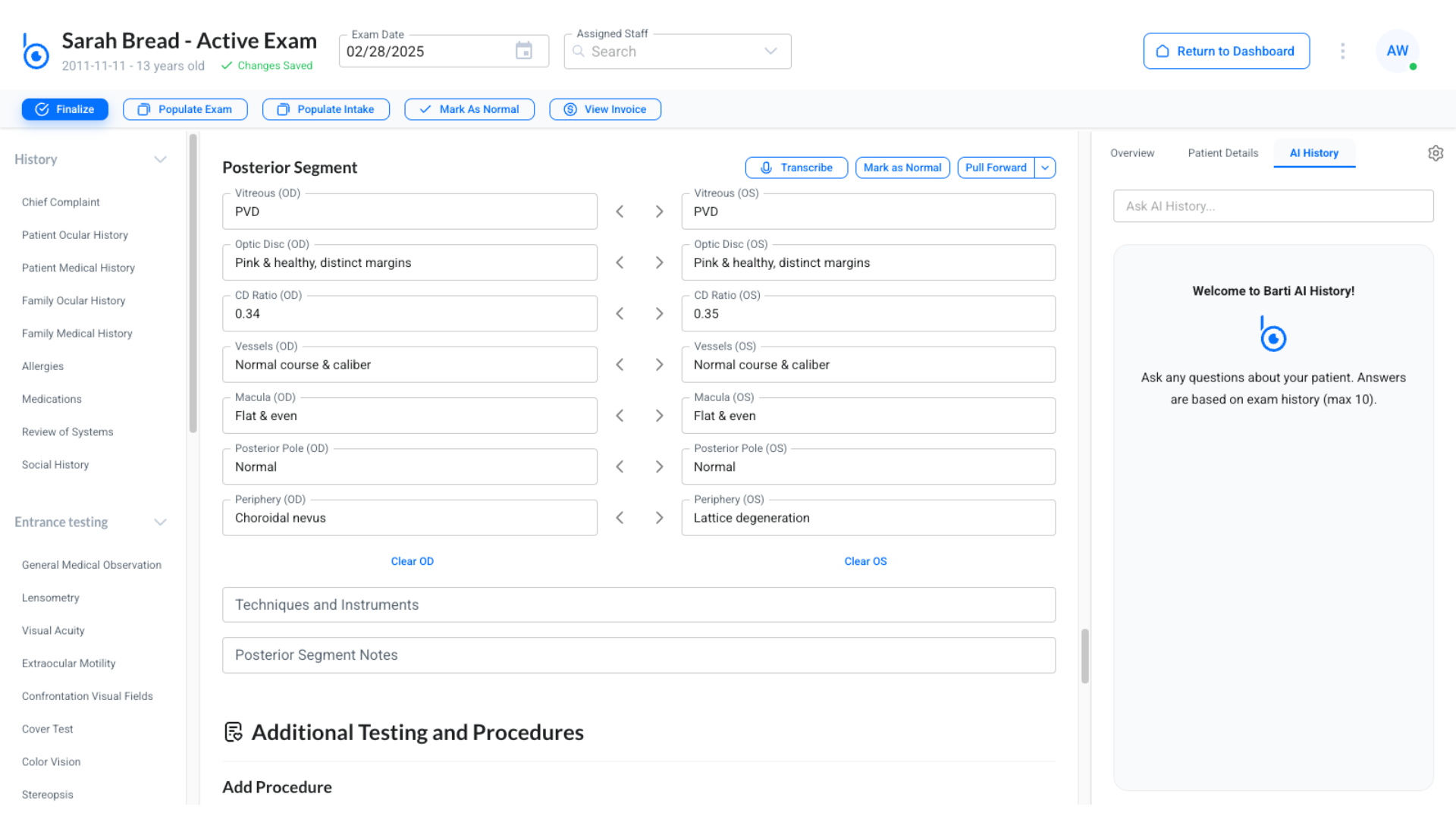
- AI effectiveness. Ask: "Chart a full eye exam by voice right now, including a contact lens Rx. Show me where each finding landed."
- Platform architecture. Ask: "Which parts did you build, and which did you acquire? Is the AI yours or a third-party add-on?"
- Workflow activation. Ask: "Show me how a tech, a provider or a biller finishes one task, start to finish."
- Ease of adoption. Ask: "Walk me through my first 90 days, week by week, from data migration to go-live."
- Security and compliance. Ask: "Where does my patients' data go when your AI processes it? Is PHI ever used to train models?"
Score each answer from 1 to 3: 3 if they showed it live, 2 if they showed part of it, 1 if they talked instead of showing. The full evaluation matrix and a printable 3-vendor scorecard are in the AI EHR Buyer's Guide.
What should you ask about AI and patient data?
Start with the basics: a signed Business Associate Agreement (BAA), encryption in transit and at rest, and role-based access controls with audit logs. Then ask the AI-specific questions. Where does patient data go when the AI processes it, and is PHI ever used to train models?
Watch out for vendors that send patient data to public AI models that keep it or learn from it. A clear, specific answer here tells you a lot about the vendor.
Does an AI EHR make clinical decisions?
The AI drafts and the provider decides. A good AI EHR writes the note, suggests codes and surfaces guidelines, but every note, guideline and claim gets a human review before it counts. Look for a platform where approving AI work is quick, and where the provider always signs.
This matters for trust inside your practice, too. Staff adopt AI faster when they know it's there to take work off their plate, with them still in charge.
How Barti handles it
Barti is the AI Operating System for eye care, endorsed by AOAExcel. EHR, practice management, phones, texting, marketing and revenue cycle management run on one platform with one log-in.
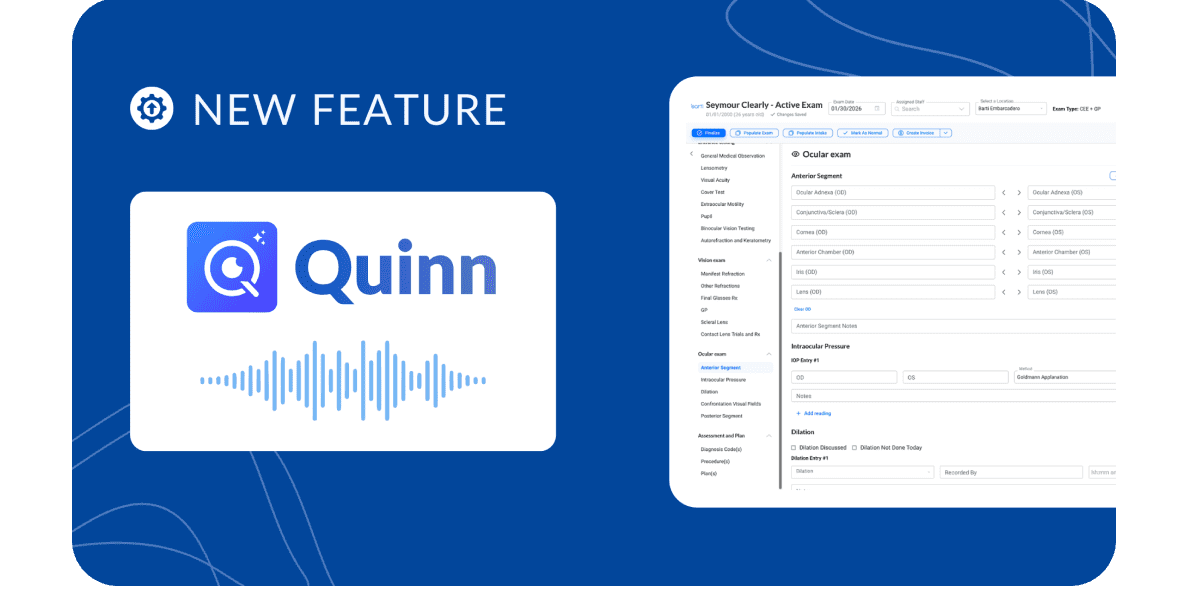
Its AI, Quinn, is built into the EHR and works inside the exam flow:
- Quinn Scribe captures the exam by voice in real time and handles up to 90% of exam documentation, filed into the right chart fields. More on how that works in our AI scribe guide.
- Quinn Guidelines brings AOA Clinical Practice Guidelines into the encounter, right where decisions happen.
- Agents in progress are taking on call handling, inventory and pricing, claim scrubbing and clinical image analysis.
Dr. Silman runs Beyond Sight Eye Care and moved off a disconnected tech stack to Barti. Read his story.
Frequently asked questions
{{ai-ehr-faq="/rich-text-component-page"}}
Get the full AI EHR Buyer's Guide
Want the complete evaluation matrix and a printable scorecard to bring to every demo? Download the free AI EHR Buyer's Guide.
Ready to score us yourself? Bring the scorecard to a Barti demo.